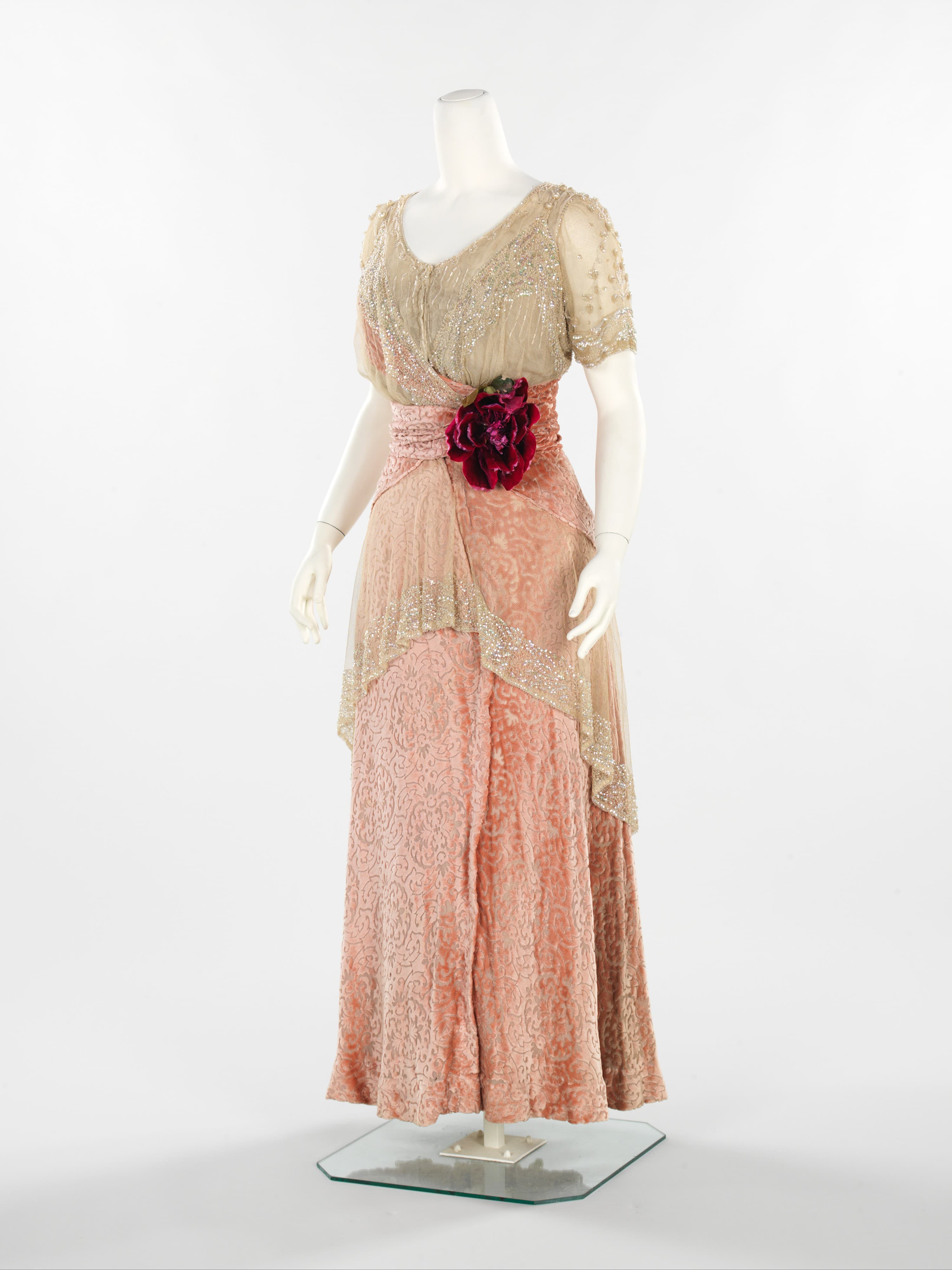


The decade splits in half almost to the day. Up to August 1914, Paris was producing the most theatrical fashion since the eighteenth century — Paul Poiret's hobble skirts, Lucile's chiffon tea-gowns, the harem trousers and lampshade tunics that read now as a brief escapist daydream. The First World War ended that overnight. By 1916, Paris couture houses were producing nurses' uniforms and the women still wearing fashion had abandoned the corset, shortened their hemlines for practicality, and adopted what looked very like men's tailored jackets for everyday wear. The decade's fashion is really two adjacent fashions with a wartime caesura in the middle.
Pre-war Paris, 1910–1914
Paul Poiret had opened at 26 avenue d'Antin in 1909 and by 1911 was the dominant force in Paris. His Persian Ball of 24 June 1911 — to which guests came in Orientalist costume designed by Poiret himself — was a calculated event that produced a year's worth of press coverage and committed his brand to a specific aesthetic. The hobble skirt (narrow at the ankle, restricting stride to about ten inches) and the lampshade tunic (wired hem worn over harem trousers) defined fashionable Paris until war broke out.
The S-bend corset of the Edwardian decade was retired by 1909–1910 in favour of a long line corset that ended at the high hip, allowing the new columnar silhouette. Some women abandoned corsets altogether for Poiret's draped pieces, which scandalised conservative observers and sold heavily to the more progressive social set.
Wartime, 1914–1918
After August 1914 the fashion press more or less stopped, and what coverage continued was patriotically practical. Hemlines shortened first because of mud (war wives walking to and from market in towns near the front) and then because of fabric shortage. By 1916 the standard dress had a hemline at mid-calf, a tailored bodice that read as a feminised version of a man's jacket, and minimal ornamentation. Wartime corsetry was substantially reduced; brassieres in the modern sense appeared in volume during these years (Mary Phelps Jacob patented a soft brassiere design in November 1914).
Uniforms entered the female wardrobe at scale for the first time. Nurses, Red Cross volunteers, women in factory work, women in agricultural service: each had a regulated dress that read more like military uniform than civilian clothing. Surviving examples are now genuinely scarce because they were worn hard and disposed of after the war.
Current market
| Garment | Range (USD) | Notes |
|---|---|---|
| Cotton or linen day dress, pre-war | $200–$900 | Bridges Edwardian style. |
| Wool tailored suit, wartime | $300–$1,400 | The 'feminised man's jacket' archetype. |
| Nurses or service uniform, complete | $400–$1,800 | Genuinely scarce. |
| Tea gown, pre-war | $600–$3,500 | The Lucile and Callot Soeurs market. |
| Hobble skirt or lampshade tunic, intact | $1,200–$6,000 | Real Poiret examples reach $25,000+; see /designers/poiret. |
| Poiret labelled piece, hand-numbered | $8,000–$60,000 | The hand-written model number is the diagnostic. |
Authentication notes
- Pre-war 1910s pieces still use hook-and-eye closures, no zippers. Closures are usually at the side or back.
- Hobble skirts have a documented narrow hem (28–32 inches at the floor); wider hems indicate alteration.
- Poiret labels with hand-written ink numbers are the strongest authentication signal for the era's couture.
- Wartime fabric tends to be heavier and coarser than pre-war — utility wool rather than fine merino, cotton sailcloth rather than fine lawn.
- Mary Phelps Jacob's original soft brassiere (patented 1914) was a tied-strap two-cup design; surviving examples are museum-rare.
Designers of the 1910s
By Margaret Hale·Published 18 May 2026·Last reviewed 18 May 2026
❦ museum holdings ❦
- · Musée Galliera, Paris (the Poiret archive)
- · The Metropolitan Museum of Art Costume Institute, New York
- · Imperial War Museum, London (the uniform collection)
- · Victoria and Albert Museum, London