How to Identify Vintage Fabrics and Fibres
Appraise a photo of yours, free.
Contents
Knowing what a vintage garment is made of tells you two things: whether it is old enough to be what the seller says, and how to clean and store it. A careful burn test on a loose thread will sort most fibres into three families (protein, plant-based cellulose, or melt-prone synthetics), and a fibre introduction timeline then tells you the earliest the garment could have been made. For exact identification, especially of blends, museum conservators use a microscope; the burn test is a quick home check, not proof.
Quick answer
- Protein fibres (wool, silk, hair) curl away from the flame, smell of burning hair and leave a crushable ash.
- Cellulose fibres (cotton, linen, rayon) catch easily, smell of burning paper and leave soft, flaky ash.
- Acetate smells sharply of vinegar and melts; synthetics such as nylon, polyester and acrylic melt and leave a hard bead.
- Use the result to rule out dates: no nylon before 1939, no polyester in US clothing before 1953, no spandex before about 1960.
- Burn tests cannot reliably identify blends, and they are destructive. Never cut into a garment to get a sample.
Before you test: take a sample safely
The American Institute for Conservation's textile identification guidance treats fibre identification as destructive testing, because the sample cannot be put back, and notes that a burn test needs a sample at least 1 cm long. For a garment you might sell or keep:
- Use a loose thread from an inside seam allowance, a frayed edge, or a spare piece in a hem or seam that is already detached.
- Test each component separately: face fabric, lining and sewing thread can all be different fibres.
- If there is no loose material, skip the burn test and rely on labels, feel and the timeline below.
Equipment: tweezers, a candle or lighter (matches add their own smell), a non-flammable dish, and water to hand. Work away from the garment, in good ventilation, and keep children and pets away.
How to run a burn test
The conservation procedure is simple:
- Hold the sample in tweezers and move it slowly toward the flame. Watch how it reacts as it approaches: does it shrink away, melt, or ignite before touching the flame?
- Put it in the flame and remove it. Does it keep burning, melt and drip, or go out on its own?
- Note the smell.
- Let the end cool and examine the residue. Is there ash or a bead? Touch it: is it soft and crushable, or hard?
- Compare your result with a burn of a known fibre if you have one. Smell descriptions are subjective.
What the results mean
| Fibre family | Near the flame | In the flame | Smell | Residue |
|---|---|---|---|---|
| Protein: wool, silk, hair | Curls away | Burns slowly, often self-extinguishes | Burning hair | Dark, crushable ash or soft bead |
| Cellulose: cotton, linen, rayon (viscose) | Ignites quickly | Burns readily, may glow | Burning paper, leaves or wood | Soft, flaky grey or black ash |
| Acetate | Melts | Melts and burns | Sharp vinegar | Hard, dark bead |
| Synthetics: nylon, polyester, acrylic | Shrinks and melts | Melts, may drip | Chemical or plastic-like | Hard, shiny bead that will not crush |
Practical points:
- Rayon burns like cotton. A burn test cannot tell them apart. Feel and drape help: regular viscose rayon has low durability and appearance retention, especially when wet, so handle it gently if you suspect it.
- Silk versus wool. Both smell of hair. Silk is usually a fine continuous filament with a high sheen; wool is crimped and springy.
- Blends confuse the result. Conservation guidance is blunt that burn testing only separates protein, cellulose and thermoplastic types and cannot identify blends. If you see both charring and melting, assume a blend.
- Finishes and dyes can change how a fabric burns. Treat surprising results with caution.
Other non-destructive clues
- Labels. Fibre-content labels became common in the US after mid-century labelling laws; see How to Date Vintage Clothing by the Label and Dating Vintage Clothing by the Care Label. Trade names are a dating clue in themselves: Orlon, Acrilan and Creslan (acrylic), Dacron and Terylene (polyester), Celanese, Acele and Estron (acetate), Dynel (modacrylic), Lycra (spandex), Bemberg (cupro).
- Static and pilling. Synthetics tend to hold static, and polyester pills are hard to remove.
- Hand and drape. Linen creases sharply and holds the crease. Compare an unknown fabric with known examples you own.
- A warning about acetate. Acetate fibre is made by dissolving cellulose acetate in acetone. Nail polish remover and some solvents can therefore damage it, which matters for cleaning; see Removing Stains and Odours from Vintage Clothing.
Fibre timeline: what could exist when
Use this to test a date claim. If the fibre was not available yet, the garment, or that part of it, is later than claimed.
| Fibre | Key dates | Notes |
|---|---|---|
| Rayon (viscose) | First commercial production by Courtaulds in England, 1905; US production by American Viscose from 1910 | Earlier "artificial silks" existed (Chardonnet silk from 1884), but they are very rare in surviving clothing |
| Cupro (Bemberg rayon) | Cuprammonium process developed by Bemberg in Germany, 1890 | Often used for linings |
| Acetate | First spun commercially in the US in 1924 (Celanese); made commercially in England after the First World War | The FTC separated acetate from rayon as a fibre category in 1953 |
| Nylon | DuPont announced it in 1938; commercial production began December 1939; stockings went on national sale May 15, 1940 | Diverted to war use (parachutes) during the Second World War |
| Modacrylic | Developed in 1949 (Dynel) | Used for wigs and fake fur |
| Acrylic | Developed by DuPont in 1941, introduced to the public in the early 1950s as Orlon | Common in 1950s sweaters |
| Polyester | Patented in Britain in 1941; commercially introduced in the US in 1953 (Dacron) and Britain in 1955 (Terylene) | Ubiquitous by the 1960s and 1970s |
| Spandex | Invented at DuPont in the late 1950s (sources give 1958 or 1959); full-scale production as Lycra by early 1961 | Elastane in Europe |
Natural fibres (cotton, linen, wool, silk) do not date a garment on their own, but a natural fibre in an item claimed to be a 1970s "polyester classic" may suggest a different maker or market.
Putting the result to work
- Dating: a 1920s dress with polyester thread throughout has been remade or is a later piece. A "1940s" sweater in Orlon acrylic is probably early 1950s or later. See Reproduction vs Antique Clothing: How to Tell.
- Authentication: a designer piece in a fibre the house did not use in that period deserves scrutiny; see How to Spot Fake Designer Labels on Vintage Clothing.
- Value: silk, fine wool and good linen generally command more than equivalent synthetics, but well-preserved period synthetics, such as printed 1970s polyester, have their own buyers. Condition matters more than fibre; see Vintage Clothing Condition Grading: Mint to Fair and What Each Costs.
- Care: fibre decides how you clean and store it. See How to Clean Vintage Clothing Safely and How to Store Vintage Clothing Long Term.
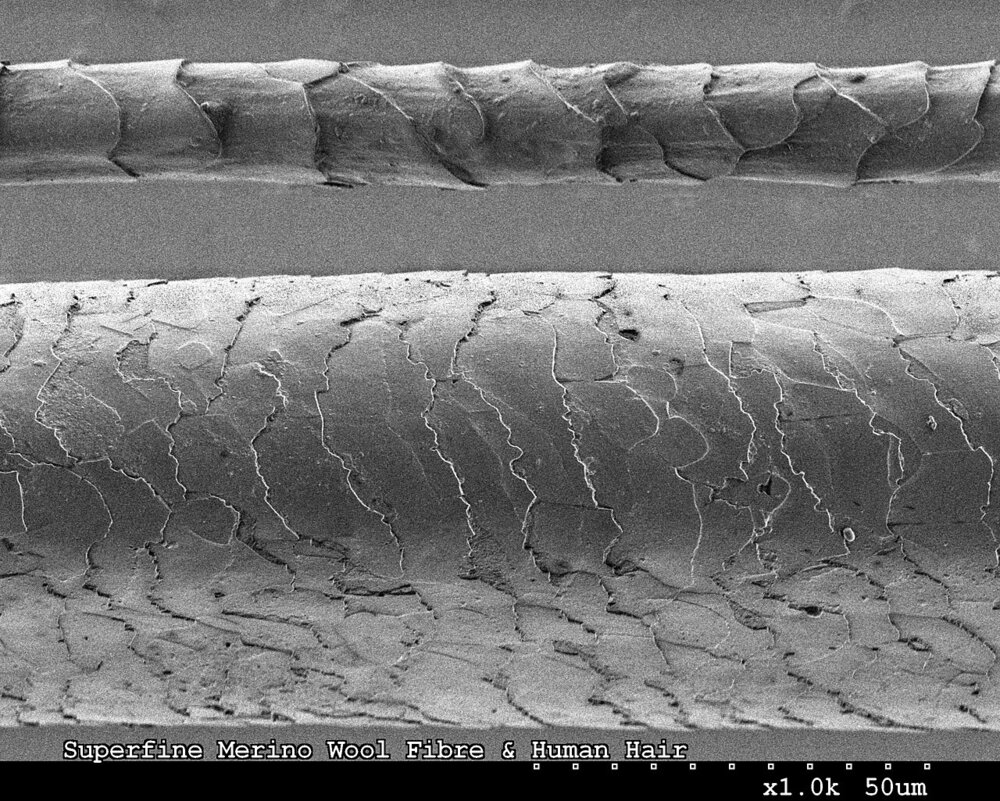
If you need a definite answer, for example for a museum donation or a high-value sale, a textile conservator or a university textile lab can identify fibres under a microscope from a tiny sample. The Ohio State University's Fiber Reference Image Library (FRIL) shows what those microscope views look like.
 123
123- Wool, a protein fibre: in a burn test it curls away from the flame and smells of burning hair
- Human hair, also a protein fibre: wool, silk and hair all burn the same way
- Magnification and scale bar (x1.0k, 50 um): fibre detail needs a microscope, not a flame
Not sure what you have? Appraise a photo
Sources
- American Institute for Conservation, Textile Specialty Group (Conservation Wiki) — Fiber Identification
- By Hand London — The Burn Test: how to identify the fibres in your mystery fabric
- Vintage Fashion Guild — Fabric Resource: Rayon, viscose
- Vintage Fashion Guild — Fabric Resource: Acetate
- Vintage Fashion Guild — Fabric Resource: Nylon
- Vintage Fashion Guild — Fabric Resource: Polyester
- Vintage Fashion Guild — Fabric Resource: Acrylic
- Vintage Fashion Guild — Fabric Resource: Modacrylic
- Vintage Fashion Guild — Fabric Resource: Spandex
- Wikipedia — Rayon
- Wikipedia — Nylon
- Wikipedia — Cellulose acetate
- Ohio State University — Fiber Reference Image Library (FRIL)
Free vintage label dating cheat sheet, by email:
Eras: VictorianEdwardian1910s1920s1930s1940s1950s1960s1970s1980s
Related
- How to Spot Fake Designer Labels on Vintage ClothingTell a genuine vintage designer piece from a counterfeit, licensed product or adaptation by checking the label, construction, fabric and history.
- How to Tell Real Fur and Leather from FauxSimple hands-on tests to tell real fur from fake fur and real leather from leatherette on vintage coats, stoles and bags, plus old fur trade names decoded.
- Reproduction vs Antique Clothing: How to TellUse fibres, fasteners, seam finishes, labels and silhouette to tell a real Victorian or Edwardian garment from a costume, revival dress or reproduction.
- Is It Vintage or a Reproduction? A ChecklistA clue-by-clue checklist for telling genuine vintage from reproductions: zippers, seams, thread, fibers, buttons, labels, tees, designer tags and aging.