How to Date Vintage Clothing by the Label
Appraise a photo of yours, free.
Contents
A label rarely tells you the exact year a garment was made, but it can almost always tell you the earliest year. US labeling laws, Post Office address formats, fiber trade names and even country names all changed on dates you can look up. Read every word on every label (and look for the labels you might have missed), then take the latest clue you find. That clue sets the earliest possible date.
Quick answer
- A sewn-in care label means the garment was almost certainly made in or after 1972 (US). Care symbols with no words point to 1997 or later.
- A fiber content label on a US garment is usually 1960 or later. Wool items could carry fiber content from 1941.
- An RN number means 1952 or later. A WPL number means 1941 or later.
- A 5-digit ZIP code in the address means July 1963 or later. A city plus a one- or two-digit postal zone ("New York 18, N.Y.") points to 1943 to 1963.
- "Made in U.S.A." became mandatory on domestic garments in 1985. Before then, many American garments said nothing about where they were made.
- A label shows when something was made at the earliest. Brands kept the same label design for years, and labels can be moved from one garment to another.
First, find all the labels
Before the 1970s, labels were not always at the center back neck. The Vintage Fashion Guild advises checking side seams and hems on older garments. You may find a maker's label at the neck, a size tag elsewhere, a union label sewn into a side seam and a fiber or care label lower down. Each label can date the piece on its own, so count them before drawing any conclusion.
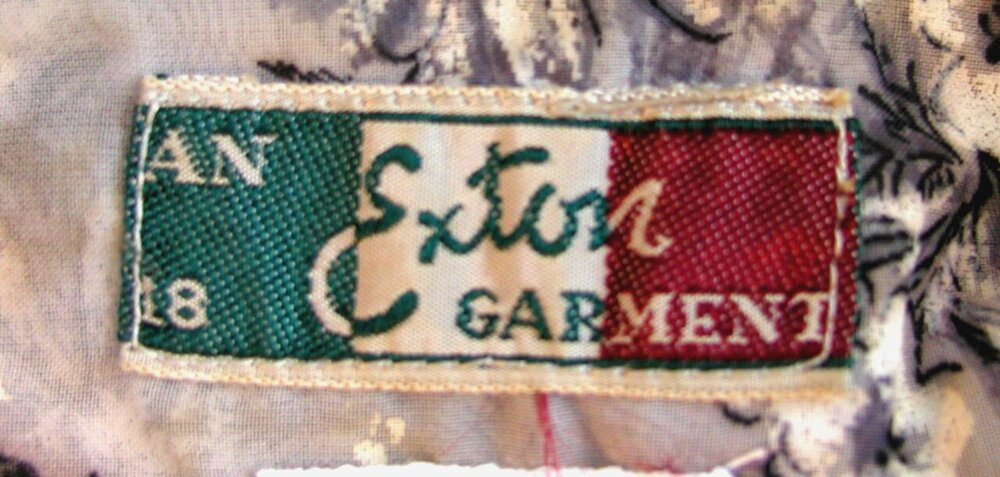
Look at the label itself as well. Woven labels with fine detail, printed satin or rayon tapes, and later printed nylon or polyester care tapes all have their own feel. Construction style alone is a weak clue, though, and the legal content of the label is much more reliable.
 123
123- Woven maker's name: woven labels have their own feel, but the wording is a far better clue than the construction
- Size woven into the label; look for every label and tag before dating
- Stitching that holds the label: if it differs from the garment's own stitching, the label may have been moved
US labeling laws: the dates that matter
These federal rules changed what a manufacturer had to put on a garment. They are the backbone of label dating.
| Law or rule | What changed on labels | Date in force |
|---|---|---|
| McKinley Tariff Act | Imports start marking country of origin | 1891 |
| Wool Products Labeling Act of 1939 | Wool items must show fiber content; WPL numbers issued | Passed Oct 14, 1940, in force nine months later (1941) |
| Fur Products Labeling Act | Furs must be named accurately (e.g. "Hudson seal" must be called sheared muskrat) | Passed Aug 8, 1951, in force August 1952 |
| RN numbers | Registered Identification Numbers can replace a company name | First used 1952 |
| Textile Fiber Products Identification Act | Fiber content required on most textiles | Passed Sept 2, 1958, in force 18 months later (March 1960) |
| FTC Care Labeling Rule | Permanent care instructions required on apparel | Issued Dec 1971, in force July 3, 1972 |
| Care Labeling Rule amendment | Clarified washing and drycleaning instructions | 1983 |
| Textile Act amendment | "Made in U.S.A." required on domestic garments | 1985 |
| FTC conditional exemption | ASTM care symbols allowed in place of words | 1997 |
Three points trip people up:
- Fiber content in the early 1960s was often on a hang tag, not a sewn-in label. The Vintage Fashion Guild notes the information "was most often presented on a disposable paper hang tag rather than on a permanently affixed label." So a 1962 dress with no fiber label is perfectly normal. The rule works one way only: a fiber label suggests 1960 or later, but having no fiber label does not prove the garment is earlier.
- Wool is the exception. Wool garments had to show fiber content from 1941, so a "100% wool" label on a coat can be 1940s.
- Care labels are the sharpest single dividing line. The FTC rule was issued in December 1971 and permanent care labels were required from 1972. A sewn-in tag that says "Machine wash warm, tumble dry" is a strong sign of 1972 or later. For the full story, including the 1983 change and when symbols arrived, see the care label guide.
RN and WPL numbers get their own guide, because they are more useful for finding the maker than for finding the year.
Address clues: postal zones and ZIP codes
Many labels from the 1940s to the 1960s print the maker's city. The format of that address is a well-documented and underused dating clue.
| Address format on label | Earliest date |
|---|---|
| City and state only ("Dallas, Texas") | Any period |
| City with a postal zone number ("New York 1, N.Y.", "Los Angeles 15, Calif.") | May 1943 |
| Five-digit ZIP code ("New York, N.Y. 10018") | July 1, 1963 |
| Two-letter capitalized state code ("NY", "CA") | October 1963 |
The Post Office brought in numbered postal zones for 124 large cities in May 1943. Five-digit ZIP codes started on July 1, 1963. The official two-letter state abbreviations were published that October. A label reading "Chicago 6, Ill." was most likely printed between 1943 and the mid-1960s. Old label stock kept being used after ZIP codes arrived, so a zone number is not proof of a pre-1963 garment. A ZIP code, though, is very hard to explain on anything earlier.
Fiber names and trade names
Once fiber content appears on a label, the fiber names help too. Nothing can be older than the fiber it is made from. These dates come from the Vintage Fashion Guild's manufactured fiber timeline and quick dating tips:
| Name on the label | First commercial use (US unless noted) |
|---|---|
| Rayon (the name) | Coined 1924; the fiber itself is older (US production from 1910) |
| Acetate / Celanese | 1924 in the US |
| Nylon | 1939; stockings sold to consumers from May 1940; little other clothing until after WWII |
| Acrylic (e.g. Orlon, Acrilan) | 1950 |
| Polyester (e.g. Dacron) | 1953 in clothing |
| Triacetate (e.g. Arnel) | 1954 |
| Spandex (e.g. Lycra) | 1959 |
| Antron nylon | 1960 |
| Olefin | 1961 |
| Woolmark symbol | 1964 |
| Qiana nylon | 1968 |
| Lyocell | 1993 |
"Sanforized" on a cotton label refers to a shrinkage-control process patented by Sanford Cluett in 1930, so it points to 1930 or later. Sanforized labels then appear for decades.
Country names that date themselves
Some country names on labels only existed for a set number of years:
- Occupied Japan: the Allied occupation ran from September 2, 1945, until April 28, 1952. "Made in Occupied Japan" belongs to that window.
- West Germany: the Federal Republic existed under that common name from May 23, 1949, to reunification on October 3, 1990. "Made in West Germany" falls inside those dates.
Remember the 1985 rule as well. Before then, many American-made garments carried no origin line at all. A label that reads "Made in U.S.A." is not automatically 1985 or later, but no origin statement on a US maker's garment fits the decades before 1985.
Union labels
Union labels are among the most precisely datable labels in American clothing. The ILGWU changed its label design several times, and the change to red, white and blue in 1974 is easy to spot. AFL-CIO wording means 1955 or later. The full timeline, with the earlier NRA and Consumers' Protection labels, is in the ILGWU union label guide.
Brand and store label histories
The label design of a specific brand is often the best clue of all, because makers changed their logos, typefaces and wording over time. Some examples documented by collectors:
- Levi's: a red tab with a capital "E" (LEVI'S) means before 1971. A lowercase "e" (Levi's) means 1971 or later.
- Lilly Pulitzer: The Vintage Traveler's comparison of 1960s and 1970s pieces found "Lilly Pulitzer Inc." added to the label in the late 1960s and a copyright symbol added a little later, probably in the early 1970s.
- Department stores: a store label only dates a garment to the years the store traded, and some stores traded for a century. The Vintage Traveler's example is San Francisco's Emporium (1896 to 1996), where the label style narrowed the date far more than the store dates did.
The Vintage Fashion Guild Label Resource holds dated photographs of thousands of designer and maker labels. When you know the brand, compare your label against the dated examples there before relying on anything else.
Where label dating goes wrong
- Labels show the earliest possible date. A label design or address could be used for years after it was introduced. Leftover label stock was used up as well.
- Absence proves little. Labels were cut out, wore away or were never sewn in. Home-sewn garments usually have no maker's label at all.
- Labels move. Designer labels get unpicked and sewn into other garments. If the label stitching differs from the garment's other stitching, or there are old needle holes nearby, be suspicious. Our guide to designer label fakes covers this.
- Reproductions copy old labels. Vintage-style brands and costume makers reproduce period labels. Check that the construction matches what the label claims (see dating by construction and dating by zippers).
- Foreign garments follow other rules. The US dates above apply to garments sold in the US. A garment made and sold in Europe will not have a US care or fiber label even if it is from 1980.
A worked example
A wool-blend dress has: a maker's label reading "Fashions by Jo, Dallas 1, Texas"; a fiber label reading "55% Dacron polyester, 45% wool"; and no care label.
- The Dallas postal zone points to 1943 to the mid-1960s.
- Dacron polyester in clothing points to 1953 or later.
- No care label fits a date before 1972, but this is the weakest clue, since the label could have been removed.
Best estimate: mid-1950s to mid-1960s. Cut and fabric would narrow it further, and our 1950s and 1960s era guides can help with that.
Not sure what you have? Appraise a photo
Sources
- Vintage Fashion Guild — Quick Tips for Dating Vintage
- Vintage Fashion Guild — Manufactured fiber timeline
- Vintage Fashion Guild — Label Resource
- Cornell Kheel Center — ILGWU Union Label Timeline
- Cornell LII — 15 U.S. Code § 68 (Wool Products Labeling Act, effective date note)
- Cornell LII — 15 U.S. Code § 69 (Fur Products Labeling Act, effective date note)
- Cornell LII — 15 U.S. Code § 70 (Textile Fiber Products Identification Act, effective date note)
- Cornell LII — 16 CFR Part 423, Care Labeling Rule
- FTC — Care Labeling Rule advance notice, 2011 (rule history)
- FTC — Threading Your Way Through the Labeling Requirements Under the Textile and Wool Acts
- Wikipedia — ZIP Code (postal zones 1943, ZIP codes 1963)
- Wikipedia — Sanforization
- Wikipedia — Occupation of Japan
- Wikipedia — West Germany
- The Vintage Traveler — Comparing Details as an Aid to Dating Vintage Clothing
- The Vintage Traveler — They Took Off Like Zingo (Lilly Pulitzer labels)
Free vintage label dating cheat sheet, by email:
Labels in this guide: ILGWULevi'sLilly Pulitzer
Eras: VictorianEdwardian1910s1920s1930s1940s1950s1960s1970s1980s
Related
- Dating Vintage Clothing by Buttons, Snaps and FastenersHow button materials (celluloid, casein, Bakelite, acrylic), snaps and Velcro help date vintage clothing, and why buttons are the least reliable clue.
- Dating Vintage Clothing by the Care LabelHow US, Canadian and European care labels date a garment: the 1971 FTC rule, the 1983 rewrite, 1997 symbols, and the clues that fool people.
- How to Date Vintage Clothing by Its ConstructionRead seams, stitching, seam finishes and cut to date vintage clothing, from hand sewing and chain stitch to pinked seams, overlocking and armhole gussets.
- How to Date Vintage Clothing by the ZipperUse zipper type, placement, brand and material to date vintage clothing: metal Talon zippers, side-seam closures, the 1960 nylon coil, and concealed zips.