How to Date Vintage Clothing by Its Construction
Appraise a photo of yours, free.
Contents
Turn the garment inside out. How it was sewn often dates it better than the label does, because labels can be moved, cut out or copied, while seams can't be changed without leaving traces. The main questions are: was it sewn by hand or by machine, which stitch was used, how were the raw edges finished, and does the cut match the period it claims to be from? No single feature dates a garment. Several features that agree with each other can.
Quick answer
- Entirely hand-sewn: points to before the 1860s, or to couture or home sewing of any date. Hand finishing alone is not old.
- Machine lockstitch seams: rarely before about 1870. Hand and machine sewing were combined into the 1880s and beyond.
- Pinked or turned-and-stitched seam allowances: typical of ready-to-wear before the 1970s.
- Overlocked (serged) edges: common in ready-to-wear from the 1970s, but used on sportswear and swimwear from the 1910s to 1920s. The machine dates to 1889.
- Garment details with known date ranges (cartridge pleating, armhole gussets, two-piece wartime suits) can narrow a date to a decade.
Step 1: hand or machine?
Look at a long straight seam such as a side seam or skirt panel. Machine stitches are perfectly even in length and spacing. Hand stitches vary slightly, and you can often see where the sewer started a new thread.
The Vintage Fashion Guild gives this timeline:
| Date | Development | What you see |
|---|---|---|
| 1829 | First practical sewing machine, used for French army uniforms | Not on civilian clothes |
| After 1845 | Machines come into common civilian use | Early machine seams appear |
| Before about 1870 | Chain stitch dominant; lockstitch seams rare | Chain stitch unravels when pulled from one end |
| Up to the 1880s and later | Hand and machine construction used together | Machine seams with hand-sewn finishing, linings and trims |
| 1873 | Zigzag machine patented by Helen Blanchard | Industrial use only at first |
| 1889 | Overlock machine patented by the Merrow Machine Company | Edges wrapped with looped thread |
| 1947 | Necchi zigzag machine for home use | Home-sewn zigzag finishes after this |
Do not over-read hand stitching. Hand finishing (hems, linings, buttonholes, attaching trims) carried on in good-quality clothing all through the 20th century, and couture is hand-finished to this day. A hand-sewn hem on a 1960s dress means care, not age. The test is whether the main structural seams are hand-sewn. If they are, and the garment is not couture or obviously home-made, it is probably early.
 123
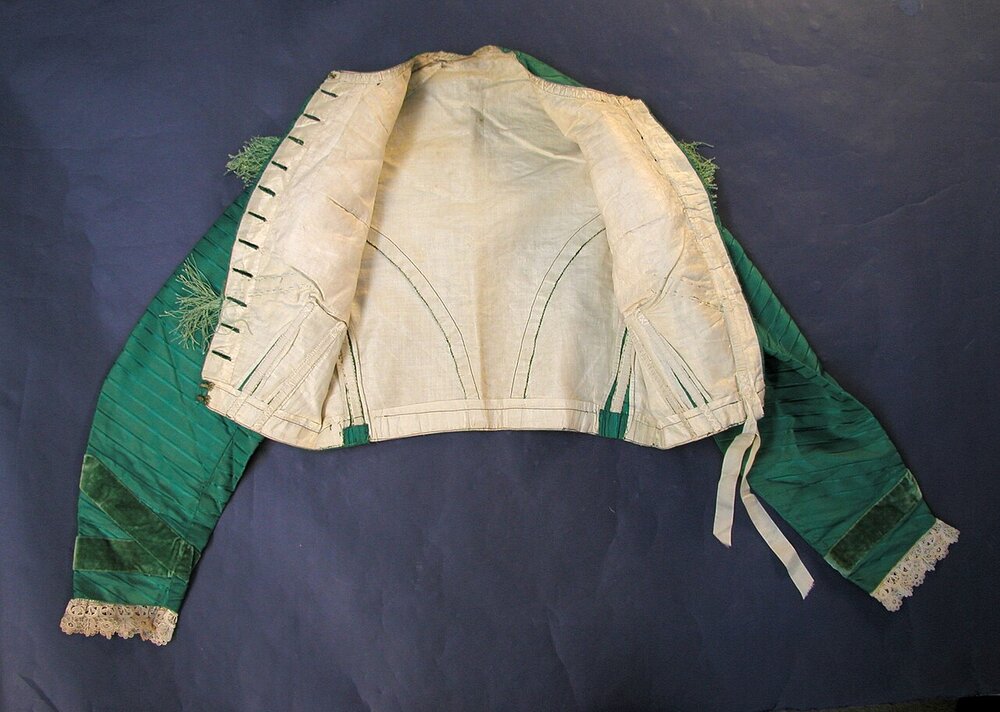
123- Row of buttonholes along the front edge: hand finishing like this continued in good clothing long after machines arrived
- Hooks at the front edge; hand-sewn hooks and eyes are typical of 19th and early 20th century dresses
- Curved back seams: hand and machine construction were used together into the 1880s
Step 2: which machine stitch?
Pull gently at a loose end of thread on an inside seam (on a hidden area, and only if you can do it without damage):
- Chain stitch forms loops on the underside and can unravel along the whole seam if the end is pulled. Early sewing machines used it. A double chain stitch is still used in denim jeans and some other industrial sewing, so on denim it says nothing about age.
- Lockstitch looks the same on both sides and does not unravel in one pull. The Vintage Fashion Guild says lockstitch seams are rarely found before 1870.
Step 3: how were the raw edges finished?
Inside, look at the seam allowances (the fabric between the stitching line and the cut edge). Seam finishes changed over time and are one of the most useful clues.
| Seam finish | What it looks like | Typical dating meaning |
|---|---|---|
| Raw or hand-overcast | Cut edge left plain, or wrapped by hand with diagonal stitches | 19th and early 20th century; also couture |
| Pinked | Zigzag cut edge made by pinking shears | Very common in ready-to-wear and home sewing before the 1970s |
| Turned and stitched | Edge folded under and stitched like a small hem | Common before the 1970s |
| French seam | Raw edges enclosed inside a narrow second seam | Lingerie, blouses and sheer fabrics in many periods |
| Flat-felled | Both edges folded and stitched flat, two rows visible outside | Shirts, workwear and jeans in many periods |
| Bound | Edges wrapped in bias binding or tape | Better quality and unlined jackets in many periods |
| Zigzag | Machine zigzag over the edge | Industrial from the late 19th century; home sewing after 1947 |
| Overlocked (serged) | Thread loops wrapped over a trimmed edge | Common in ready-to-wear from the 1970s; earlier on knits, sportswear and swimwear |
 123
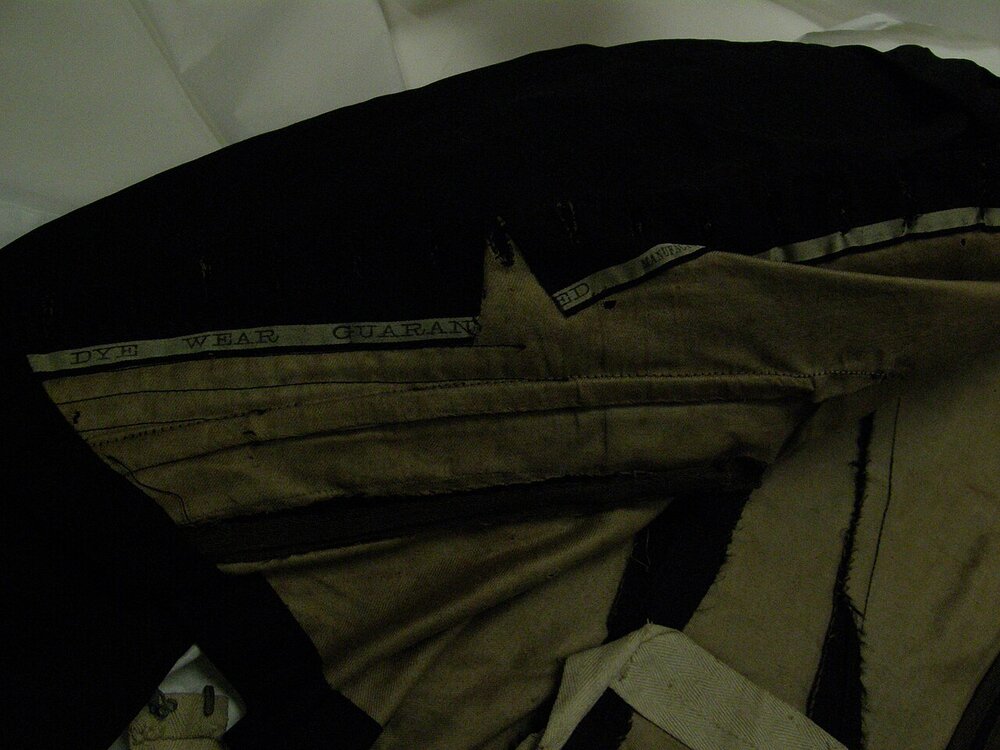
123- Seam allowance with its cut edge left plain, a finish typical of the 19th and early 20th century
- Even line of stitching across the lining: machine seams with hand finishing, as the museum records here
- Printed selvedge reading DYE WEAR GUARAN(TEED), recorded in the museum catalogue
Pinking
Pinking shears are older than many people think. Before scissors, a pinking iron punched out a zigzag edge with a mallet. Louise Austin patented the best-known pinking shears design in 1893, a pinking machine was being described to the trade in 1916, and Samuel Briskman's company patented a popular design in 1934. Pinked seams therefore suit any date from the late 19th century to the 1960s, and are not limited to the 1930s to 1950s.
The serger rule, and why it is shaky
You will often read that "an overlocked seam means the garment is from the 1970s or later." That is mostly true for ordinary woven dresses, blouses and skirts, but it is too strong as a rule:
- The overlock machine was patented by Joseph Merrow of the Merrow Machine Company in 1889. (Some accounts give 1881 for the invention.)
- The Vintage Fashion Guild says sergers have been used for seam finishing since the 1920s.
- Clothing historian Lizzie Bramlett (The Vintage Traveler) describes a 1910s wool swim dress with overlocked seams, and has seen overlocking on sportswear from the 1920s to the 1940s and on 1950s and 1960s pieces. In her experience, overlocking was more common early in swimwear and sportswear.
- She agrees that overlocking became prevalent in the garment industry only in the 1970s, and that before then seams were usually pinked or turned under and stitched, with flat-felled seams on shirts and French seams on lingerie and blouses.
How to use it: overlocked seams make a 1970s or later date more likely for a woven dress or blouse, but they do not prove it. On swimwear, knitwear, sportswear and lingerie, overlocking can be much older. Check the other clues before deciding.
"Merrow" is still used loosely for all overlock stitching, though strictly only 2- and 3-thread overlock is a merrow stitch.
Step 4: details with known date ranges
Some construction details are tied to particular periods. These are from the Vintage Fashion Guild's dating tips.
19th century
| Detail | Period |
|---|---|
| Watch pocket at the waistline or waistband of a dress | 1840s to 1880s |
| Watch pocket elsewhere on the bodice | From the 1880s |
| Cartridge pleating of the skirt into the waistband | 1840s to 1860s, fading by the 1870s |
| Tiny piped armhole seams | 1870s or before; rare afterward |
See the Victorian and Edwardian era guides for silhouettes.
20th century
| Detail | Period |
|---|---|
| Belt loops on men's trousers | From the early 1920s, alongside suspender buttons for years |
| Three-quarter and seven-eighths sleeves | Late 1930s to 1950s |
| Two-piece men's suits (no vest) becoming standard in the US | 1942, a wartime measure |
| Diamond-shaped gussets in the armhole | 1950s |
| High, fitted armholes | 1950s and 1970s |
| Circle stitching inside bra cups | 1950s |
| Metal (not plastic) hardware on slips, bras and garters | Vintage; plastic hardware is later |
Step 5: regional clues
Construction can also tell you where something was made:
- Hanging loops inside the neckline of jackets and blouses are usually a sign of European manufacture.
- Hem tape (a narrow woven tape along the hem edge) usually points to North American manufacture. The Vintage Fashion Guild says it was never used in Germany.
Step 6: does the construction match the label and style?
The most useful thing construction can do is catch a mismatch:
- A "1940s" dress with overlocked seams throughout, a nylon coil zipper and a care label is not from the 1940s.
- A "Victorian" bodice with lockstitched, overlocked seams and a metal zipper is a later costume or reproduction (see reproduction vs. antique).
- A dress with pinked seams, a side-seam metal zipper and a postal-zone address on the label tells a consistent mid-century story.
Fastenings belong in the same check: see dating by zippers and buttons and fasteners. Fabric content is covered in identify fabrics.
Alterations and repairs
Old garments were altered, taken in, let out and repaired, often many times. Before dating a garment by a seam, check that it is original:
- Thread of a different color, sheen or fiber from the rest of the garment.
- Needle holes or fold lines where an old seam used to be.
- Overlocking on just one or two seams of a garment otherwise pinked throughout (a later repair is likely).
An alteration does not make a garment less old, but it can affect value. Our guide to repair or leave it explains when to restore and when to leave history alone.
Not sure what you have? Appraise a photo
Sources
Free vintage label dating cheat sheet, by email:
Eras: VictorianEdwardian1910s1920s1930s1940s1950s1960s1970s1980s
Related
- Dating Vintage Clothing by Buttons, Snaps and FastenersHow button materials (celluloid, casein, Bakelite, acrylic), snaps and Velcro help date vintage clothing, and why buttons are the least reliable clue.
- How to Date Vintage Clothing by the LabelUse the laws, postcodes, fiber names and country names printed on a garment label to work out the earliest year it could have been made.
- How to Date Vintage Clothing by the ZipperUse zipper type, placement, brand and material to date vintage clothing: metal Talon zippers, side-seam closures, the 1960 nylon coil, and concealed zips.
- Dating Vintage Clothing by ILGWU and Other Union LabelsHow to date American garments by their ILGWU, ACWA, NRA and Consumers' Protection labels, with a period-by-period chart and where the dates disagree.