How to Date Vintage Clothing by the Zipper
Appraise a photo of yours, free.
Contents
A zipper can rule a date out quickly. Zippers were rare in women's clothing before the early 1930s, so a "1920s flapper dress" with a zipper down the back is almost certainly later. The most useful facts are where the zipper sits (side seam, short neck opening or full center back), what it is made of (metal or nylon coil), and how it is branded. Taken together, they will usually place a garment within a couple of decades.
Quick answer
- Zipper in a woman's dress or skirt: usually 1930s or later. Zippers became common in clothing in the early-to-mid 1930s.
- Metal zipper in the left side seam of a dress: typical of the late 1930s to 1960s.
- Long center-back zipper in a dress: occasional in the 1940s and early 1950s, mostly late 1950s onward, and in most dresses from the 1970s.
- Nylon (plastic coil) zipper: introduced to clothing makers in 1960. Metal and nylon were both used through the 1960s and 1970s.
- Concealed (invisible) zipper: YKK launched its "Conceal" line in 1958, so it does not prove a 1970s or later date.
- Brand names help: Talon (US), Lightning (Canada), Eclair (France), Riri (Switzerland), YKK (Japan, founded 1934).
A short history with the dates that matter
| Date | Event | Why it matters |
|---|---|---|
| 1893 | Whitcomb Judson patents the "clasp locker" and shows it at the Chicago World's Fair | A shoe fastener, not used in clothing |
| 1905 | The C-Curity placket fastener goes on sale, with hooks and eyes on tape | Advertised for skirt plackets, but it rusted and had to be removed before washing. Very rare |
| 1913 | Gideon Sundback's "Hookless No. 2" with interlocking teeth; the Hookless Fastener Co. moves to Meadville, Pennsylvania | The first modern zipper. Patent issued 1917 |
| 1916 | About 30 makers of women's skirts use the Hookless in their 1916 lines, according to company records cited by historian Robert Friedel | Early, scattered use in clothing; sportswear makers were keen |
| 1917 to 1919 | WWI money belts and flying suits; then tobacco pouches take most of the output | Not fashion |
| 1922 to 1923 | B.F. Goodrich puts the fastener in rubber galoshes called "Zipper" boots | Source of the word "zipper" |
| 1925 | Schott uses zippers in leather jackets | Early menswear and outerwear use |
| Early 1930s | Zippers spread into clothing: a 1932 Vogue pattern suggests a Talon fastener at the neck; many zipper ads from 1932 | Start of real use in women's clothing |
| 1935 | Schiaparelli shows colored plastic zippers as visible decoration | Fashion acceptance |
| 1937 | Zippers win the "Battle of the Fly" in men's trousers; Hookless Fastener Co. renamed Talon, Inc. | Zippers become ordinary |
| 1958 | YKK introduces "Conceal" zippers with hidden teeth | Concealed zippers exist from here |
| 1960 | Talon launches the Zephyr nylon coil zipper | Start of nylon coil zippers in ready-to-wear |
| 1960s and 1970s | Metal and nylon zippers both in use | Material alone cannot separate these decades |
Sources differ on some of these dates. The tobacco pouch contract is given as 1918 in one account and 1919 in another, and the Goodrich boot as 1922 or 1923. None of these differences affects dating a garment.
Rule 1: placement
The position of the zipper is often the strongest clue. The Vintage Fashion Guild gives these ranges:
| Placement | Typical period |
|---|---|
| Side seam zipper in a dress (usually the left side) | Late 1930s to 1960s |
| Short center-back neck zipper | Mostly 1930s to 1940s |
| Zippers at the sleeve wrist | 1930s to 1940s |
| Long center-back dress zipper | Seen occasionally in the 1940s and early 1950s; generally later 1950s and 1960s; most dresses since the 1970s |
Before zippers, dresses closed with snaps, hooks and eyes, and buttons. Many 1920s dresses simply slip on, or close with a row of snaps and hooks at the waist and shoulder. See buttons and fasteners.
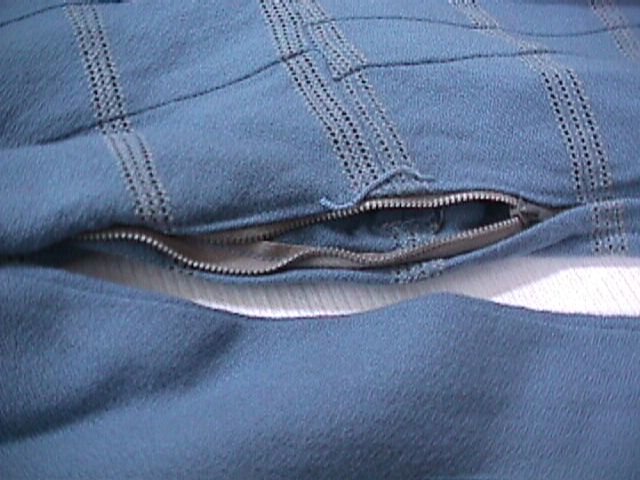 12
12- Separate metal teeth on a fabric tape: a metal zipper fits any date from the 1930s on (Rule 2)
- The opening runs along the side seam; the museum records it in the left side, typical of the late 1930s to 1960s (Rule 1)
Men's trousers: zippered flies spread in the 1930s, but the Vintage Fashion Guild notes that men's dress trousers continued to use button flies through the 1940s. A button fly on a pair of men's trousers does not make them pre-1937.
Rule 2: metal or nylon coil
Look at the teeth:
- Metal zipper: separate metal teeth (brass, nickel, or aluminum) clamped onto a fabric tape.
- Coil zipper: a continuous spiral of nylon (later polyester) stitched or woven to the tape. The "teeth" are the loops of the coil.
- Molded plastic zipper: separate chunky plastic teeth, molded onto the tape.
When did nylon coil zippers start? Some people say the late 1950s, others the mid-1960s. Clothing historian Lizzie Bramlett (The Vintage Traveler) found a September 1960 Talon ad that introduces nylon zippers to clothing buyers as "new", and Talon's own history dates the Zephyr nylon coil zipper to 1960. By 1962 it made up a third of Talon's sales. The Vintage Fashion Guild notes that coil zippers were invented around 1940 but were not in common use until the early 1960s.
The common mistake: treating "metal zipper = before 1970" as a rule. It is not one:
- Garments were made with both types throughout the 1960s.
- Home sewers kept using metal zippers into the 1970s. The same historian recalls a 1967 sewing teacher warning students off nylon zippers as unreliable.
- Heavy fabrics, coats, jeans and workwear kept metal zippers by choice, and still do.
What does work: a nylon coil zipper rules out anything before 1960, unless the zipper has been replaced. A metal zipper fits any date from the 1930s on.
Lilly Pulitzer shift dresses show the changeover well: collectors observe metal zippers on early-to-mid 1960s dresses and nylon zippers on later 1960s ones.
Rule 3: concealed and invisible zippers
A concealed (invisible) zipper hides its teeth behind the tape, so only a seam shows from the outside. People often assume these mean the 1970s or later. That is too simple:
- YKK introduced its "Conceal" brand in 1958.
- The Vintage Traveler documents a skirt set with a metal concealed zipper, dated to the early-to-mid 1960s.
Concealed zippers did become far more common in later decades. Treat one as a sign of a later date, not a cutoff.
Rule 4: brand names and markings
Turn the zipper pull over and check both sides. Brand names, patent numbers and country markings are often stamped there.
| Brand | Country | Notes |
|---|---|---|
| Talon | US | The Hookless Fastener Co. used "Talon" as a brand by 1932; the company took the Talon name in 1937. By the 1960s about seven in ten zippers were Talon. US manufacturing ended in 1998 and the name now belongs to a different company |
| Lightning | Canada (and Britain) | Gideon Sundback kept non-US rights and set up Lightning Fastener Co. in St. Catharines, Ontario |
| Riri | Switzerland | Martin Winterhalter bought Sundback's European rights in 1923 and produced zippers under the Riri name |
| Eclair | France | |
| KIN | Germany | |
| YKK | Japan | Founded January 1934; YKK trademark registered 1946; US office opened 1960 |
Talon is not a pre-1937 test either way. Because the brand name was in use by 1932, "Talon" on a pull does not mean 1937 or later. And because Talon zippers were made for decades, a Talon zipper alone does not mean "vintage" in any narrow sense.
Patent numbers stamped on pulls or tapes give a "no earlier than" date, because the item cannot predate the patent. Search the number on Google Patents. As The Vintage Traveler points out for patented labels, a US patent lasted many years, so a patent date says nothing about how late an item could be.
YKK: YKK opened its first US office in 1960, so on an American-made garment a YKK zipper most likely points to 1960 or later. On Japanese-made goods it can be earlier.
Rule 5: has the zipper been replaced?
A replaced zipper gives a wrong date, and replacements are very common because zippers break. Signs of a replacement:
- Thread that differs in color, sheen or fiber from the rest of the seams.
- Extra needle holes beside the zipper, or a seam allowance that has been re-folded.
- A zipper much newer than the fabric around it (bright tape on a faded garment).
- Machine stitching around the zipper on a garment otherwise finished by hand.
- A zipper in a style that does not otherwise use one, such as a 1920s dress with a center-back zipper.
The Vintage Traveler's rule of thumb: if someone says they have a 1920s dress with a zipper, it is very likely a 1960s dress. A 1960s dress in 1920s style is a revival, not a fake, and it is priced as a 1960s garment.
Worked examples
- Rayon dress, left side-seam metal zipper, snap closure at the neck, no care label: consistent with the late 1930s to 1940s. Check the cut against the 1930s and 1940s guides.
- Cotton sheath dress, long center-back metal zipper: most likely late 1950s to mid-1960s.
- Polyester knit dress, center-back nylon coil zipper, care label: 1970s is likely; the care label alone makes it 1972 or later for a US garment.
- "1920s" beaded dress with a nylon coil zipper: the zipper is either a replacement or the dress is a later piece. Examine the beading and construction (see dating by construction).
Not sure what you have? Appraise a photo
Sources
- Wikipedia — Zipper
- Wikipedia — Talon Zipper
- Wikipedia — YKK
- Vintage Fashion Guild — Quick Tips for Dating Vintage
- The Vintage Traveler — The First Use of a Zipper in Fashion?
- The Vintage Traveler — Zippers, Part II
- The Vintage Traveler — Currently Reading: Zipper, An Exploration in Novelty (Robert Friedel)
- The Vintage Traveler — Ad Campaign: Talon Zephyr, 1960
- The Vintage Traveler — Two Birds with One Stone: Zippers and Tweed
- The Vintage Traveler — Late 1950s European Train Print (metal concealed zipper)
- The Vintage Traveler — They Took Off Like Zingo (Lilly Pulitzer)
- The Vintage Traveler — Using US Patent Numbers
Free vintage label dating cheat sheet, by email:
Labels in this guide: Elsa SchiaparelliLilly PulitzerSchottTalonYKK
Eras: VictorianEdwardian1910s1920s1930s1940s1950s1960s1970s1980s
Related
- Dating Vintage Clothing by Buttons, Snaps and FastenersHow button materials (celluloid, casein, Bakelite, acrylic), snaps and Velcro help date vintage clothing, and why buttons are the least reliable clue.
- How to Date Vintage Clothing by Its ConstructionRead seams, stitching, seam finishes and cut to date vintage clothing, from hand sewing and chain stitch to pinked seams, overlocking and armhole gussets.
- How to Date Vintage Clothing by the LabelUse the laws, postcodes, fiber names and country names printed on a garment label to work out the earliest year it could have been made.
- Vintage Label Lookup: Date Clothing by Label, RN and Union TagFree printable vintage label dating cheat sheet with union label versions, RN and WPL numbers, care and fiber law dates, ZIP codes and zipper clues.