Dating Vintage Clothing by Buttons, Snaps and Fasteners
Appraise a photo of yours, free.
Contents
Buttons and fasteners can date a garment, but use them with care. Every plastic has a known first date, so a button cannot be older than the material it is made from. Velcro and zippers have firm start dates too. The catch is that buttons are the easiest part of a garment to replace. Old buttons were saved in tins and sewn onto newer clothes, and old garments were rebuttoned. Treat buttons as supporting evidence and give more weight to the seams, labels and zipper.
Quick answer
- Celluloid (often imitating ivory or tortoiseshell): 1870s onward, most typical of the late 19th and early 20th century.
- Casein or Galalith (milk-protein plastic): about 1900 onward, strongest in the 1920s and 1930s.
- Bakelite (phenolic resin): patented 1907 to 1909, popular for fashion items from the 1920s through the 1940s.
- Acrylic (Lucite, Plexiglas, Perspex): commercial from 1933.
- Snap fasteners (press studs): patented 1885, common on women's clothing by the early 20th century.
- Velcro (hook-and-loop): Swiss patent granted 1955, little used in clothing until the 1960s.
First check: are the buttons original?
Before dating anything by its buttons, check whether they belong to the garment:
- Do they all match? One odd button is a replacement. A full set that looks newer than the garment may be a complete rebuttoning.
- Look at the thread. Original buttons are usually sewn with thread matching the buttonhole stitching in color, sheen and fiber. Different thread suggests later work.
- Look for old holes and marks. Extra needle holes, a faded outline or a pressed ring around a button show that a different button used to be there.
- Do the buttons fit the buttonholes? Replacement buttons are often slightly too big or too small.
- Look for a spare. Some garments came with a spare button sewn inside a seam or onto the label. If the spare matches the buttons on the front, those are probably original.
If the buttons are replacements, they tell you about the garment's later life, not when it was made.
Button materials by date
The table below gives the earliest date each material could appear. A material that was cheap and popular stays in use long after it first appears.
| Material | How to recognize it | Earliest date / peak use |
|---|---|---|
| Shell, mother-of-pearl | Cold, heavy for size, iridescent layers, often slightly uneven | Ancient; used in every period |
| Bone, horn, wood, metal, glass | Natural materials, many styles | Used in every period |
| Vegetable ivory (corozo/tagua nut) | Cream to brown, fine grain, often dyed | 19th and early 20th century; a 1918 US government survey called it the most popular material for suit and shirt buttons |
| Celluloid | Light, often imitates ivory (with fake grain), tortoiseshell or horn | Hyatt's process patented 1870; ivory-grain imitations from 1883 |
| Casein / Galalith | Smooth, hard, takes bright dyes, can craze if heated | Hardening process found 1893; shown at the 1900 Paris Exhibition; UK production from 1914 |
| Bakelite | Dense and heavy; made in black, brown, red, yellow, green, gray and blue, and blends of these; carved or molded | Patent filed 1907, granted 1909; fashion use from the 1920s |
| Acrylic (Lucite, Plexiglas, Perspex) | Clear or tinted, glass-like | First marketed 1933 |
| Modern molded plastics | Lightweight, uniform, visible mold seams | Most common button material today |
Celluloid
Celluloid was the first widely used plastic. It was made in Britain as Parkesine (1850s and 1860s) and patented in its familiar form by John Wesley Hyatt and his brother in 1870. It was sold as a cheaper substitute for ivory under names like "French Ivory" and "Ivorine". Celluloid is highly flammable. Keep celluloid buttons away from heat and never test them with a flame.
Casein (Galalith)
Galalith is made from milk protein hardened with formaldehyde, a process the French chemist Auguste Trillat found in 1893. It was shown at the Paris Universal Exhibition of 1900 and was made in Britain as Erinoid from 1914. It takes bright colors well and was widely used for buttons. Production fell during WWII, though it carried on in places for decades (in the UK until 1980). A casein button that has been heated in washing can develop a crazed, cracked surface.
Bakelite
Leo Baekeland filed his Bakelite patent in 1907 and it was granted in 1909. From the 1920s, Bakelite became popular for jewelry, and designers such as Elsa Schiaparelli had dress buttons made from it. It was also used for British WWII uniform buttons.
Because Bakelite is collectible, check any "Bakelite" description carefully. Some collectors identify Bakelite and other early plastics with heat or chemical tests. These can mark or destroy a button, and heat is dangerous with celluloid. Don't experiment on a garment you want to sell. A specialist or our appraisal service can help.
Acrylic and Lucite
Acrylic (polymethyl methacrylate) was developed in 1928 and first sold in 1933 by Röhm & Haas as Plexiglas. Other trade names include Perspex and Lucite. Clear, carved and colored acrylic buttons can therefore be from the 1930s onward. Acrylic was widely used for decades, so it does not narrow the date much.
Snaps, hooks and eyes
Hooks and eyes have been used for centuries and give little help with dating on their own. Hand-sewn hooks and eyes are typical of 19th and early 20th century dresses. Hook-and-eye tape (hooks and eyes ready-mounted on a strip of fabric) appears in the 1922 Montgomery Ward catalog.
Snap fasteners (press studs, poppers) were patented by the German inventor Heribert Bauer in 1885 for men's trousers, and by Albert-Pierre Raymond of Grenoble in 1886. Clothing historian Lizzie Bramlett (The Vintage Traveler) notes that most 1920s dresses she has handled close with a series of snaps and hooks at the waist and shoulder, and that tapes holding snap closures were sold for dresses at the time. A row of sewn-on snaps along a side opening is very typical of 1920s and early 1930s dresses, before zippers took over.
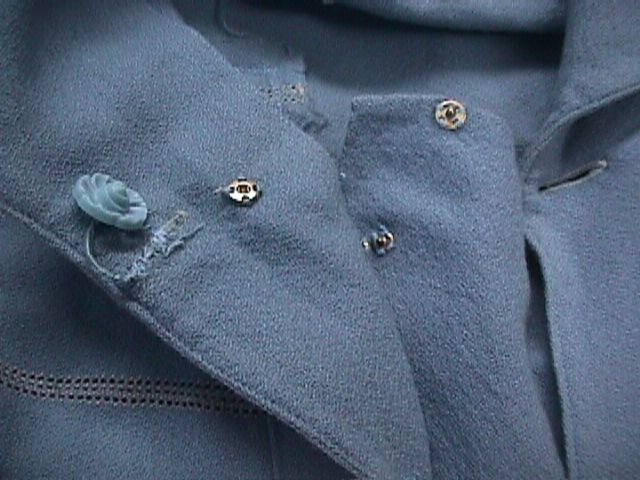 123
123- Button catalogued as plastic: a button cannot be older than the material it is made from
- Sewn-on snap fastener (press stud), patented in 1885
- Matching half of a snap on the facing panel
Pearl snaps on Western shirts became mainstream in the 1950s, when singing cowboys such as Gene Autry and Roy Rogers wore them on stage shirts.
Velcro (hook-and-loop)
Velcro is easy to date and useful for catching reproductions:
| Date | Event |
|---|---|
| 1941 | George de Mestral has the idea after a hunting trip |
| 1951 | Swiss patent filed |
| 1955 | Swiss patent granted |
| 1957 | Production starts in Manchester, New Hampshire |
| 1958 | First US press mention ("a zipperless zipper") |
| 1959 | Shown at a fashion show at New York's Waldorf-Astoria |
| 1960s | Begins to appear in clothing, first in sports and outdoor gear; the Vintage Fashion Guild says it was little used in clothing before the 1960s |
Original Velcro on a garment means about 1960 or later. Velcro on a garment that otherwise looks 1940s is either a later alteration or a sign that the piece is later than it appears.
Zippers
Zippers have their own guide: see dating by zippers. In short, zippers in women's clothing are generally 1930s or later, and nylon coil zippers are 1960 or later.
Lingerie and foundation hardware
The Vintage Fashion Guild notes that vintage slips, bras and garters have metal hardware (slides, rings, hooks and garter clips), not plastic. Plastic adjusters on a slip or bra point to a later date. For lingerie, the hardware is often a better clue than the label.
Belt buckles
Buckles follow the same materials timeline as buttons: celluloid, casein, Bakelite and acrylic buckles have the same earliest dates as the buttons in the table above.
Putting fastener clues together
| What you see | Likely reading |
|---|---|
| Row of snaps and hooks at a side opening, no zipper, slip-on cut | 1920s to early 1930s style (check construction) |
| Side-seam metal zipper plus Bakelite or casein buttons | Late 1930s to 1940s fits |
| Acrylic buttons, center-back metal zipper | 1950s to 1960s fits |
| Velcro closure | 1960s or later |
| Plastic bra or slip hardware | Later, not early vintage |
These readings only work when the other evidence agrees. Check them against construction and labels before deciding.
Do buttons affect value?
Sometimes a great deal. Original carved Bakelite or designer buttons can add real value to a 1930s or 1940s jacket or dress, and replacing them can take value away. Loose vintage buttons are a collecting field of their own: you can check sold prices for vintage bakelite buttons on eBay to see what sets actually sell for. If a garment is missing buttons, see repair or leave it before swapping in modern ones.
Not sure what you have? Appraise a photo
Sources
Free vintage label dating cheat sheet, by email:
Labels in this guide: Elsa SchiaparelliMontgomery Ward
Eras: VictorianEdwardian1910s1920s1930s1940s1950s1960s1970s1980s
Related
- How to Date Vintage Clothing by Its ConstructionRead seams, stitching, seam finishes and cut to date vintage clothing, from hand sewing and chain stitch to pinked seams, overlocking and armhole gussets.
- How to Date Vintage Clothing by the LabelUse the laws, postcodes, fiber names and country names printed on a garment label to work out the earliest year it could have been made.
- How to Date Vintage Clothing by the ZipperUse zipper type, placement, brand and material to date vintage clothing: metal Talon zippers, side-seam closures, the 1960 nylon coil, and concealed zips.
- RN and WPL Numbers: What They Tell You About Vintage ClothingWhat RN and WPL numbers on clothing labels mean, the earliest dates they prove, how to look one up, and why RN-to-year charts are unreliable.