Dating Vintage Clothing by ILGWU and Other Union Labels
Appraise a photo of yours, free.
Contents
If an American women's garment carries an ILGWU union label, you can usually date it to within about ten to twenty years from the label design alone. The International Ladies' Garment Workers' Union changed its label at known points: AFL-CIO wording from 1955, a redesign stressing "union made" in 1963, and a red, white and blue label with "Made in U.S.A." from 1974 until the union merged away in 1995. Men's clothing has a parallel system in the ACWA labels.
Quick answer
- "AFL-CIO" on the label (often in tiny print) means 1955 or later. The two federations merged that year.
- Blue and white label with "union made" emphasized: about 1963 to 1974.
- Red, white and blue label with "Made in U.S.A.": 1974 to 1995.
- NRA Blue Eagle label: 1933 to 1935 only.
- Consumers' Protection label (coat and suit industry): 1935 to about 1959/1960.
- "UNITE" on a label means 1995 or later.
Why union labels are so useful
Most label clues only give a "made no earlier than" date. Union labels are better, because the union changed its design and then stopped using the old one. A label design with both a start date and an end date gives you a window, not just a floor.
They are also common. Cornell's Kheel Center, the ILGWU's official archive, records that by 1961 more than 880 million ILGWU labels a year were going into garments leaving union shops.
The ILGWU in brief
The ILGWU was formed in New York City in 1900. It represented workers in the women's garment industry in the US and Canada, peaked at about 450,000 members, and merged with the Amalgamated Clothing and Textile Workers Union (ACTWU) in 1995 to form UNITE (the Union of Needletrades, Industrial and Textile Employees).
Its relationship with the big labor federations matters for label dating:
- The ILGWU was an AFL union. In 1935 it was a founding member of the Committee for Industrial Organization (CIO) formed inside the AFL.
- It drifted away from the CIO and went back to the AFL in 1940.
- The AFL and CIO merged in 1955, and the union's labels then carried "AFL-CIO".
ILGWU and related label timeline
| Period | Label | What to look for |
|---|---|---|
| 1900 onward | Early ILGWU label | Adopted at the founding convention but optional and rarely used. The Kheel Center says the first label drive ended after five years with only one company still using it. Expect to see very few. |
| 1924 to 1929 | Prosanis | Issued by New York's Joint Board of Sanitary Control. Not a union label as such, but tied to union shop conditions. |
| 1933 to 1935 | NRA Blue Eagle | The National Recovery Administration eagle. The coat and suit industry was the first apparel trade to adopt it. The Supreme Court struck down the NRA in 1935. |
| 1935 to about 1959/60 | Consumers' Protection label | Issued by the National Coat and Suit Industry Recovery Board, which carried on the NRA code voluntarily. Merged with the ILGWU label in May 1960. |
| 1936 onward | ILGWU label (Union Label Office) | The ILGWU set up a Union Label Office in 1936, when 32 firms were using the label. |
| Pre-1955 | ILGWU label, AFL era | No "CIO" in the wording. |
| 1955 to 1963 | ILGWU label with AFL-CIO | The Vintage Fashion Guild dates its late-1950s example to 1955-1963. |
| 1959 | Industry-wide launch | The ILGWU label was launched across the garment industry on January 9, 1959, with Mary Rockefeller and Eleanor Roosevelt among the women at launch events. |
| 1963 to 1974 | Redesigned label | Design changed "to emphasize the words 'union made'". |
| 1974 to 1995 | Red, white and blue label | Adds "Made in U.S.A." Part of the union's campaign against imports. |
| 1995 onward | UNITE | The ILGWU and ACTWU merged. |
Two smaller details from the Kheel Center can help:
- From 1958, a small blue printed fabric rectangle about 1 1/4 by 7/8 inches was used on basic outerwear.
- From 1959, the union controlled its labels with code letters and serial numbers that identified the employer. A 1982 union letter said the manufacturer could once be traced from those letters and numbers, but no public lookup exists today.
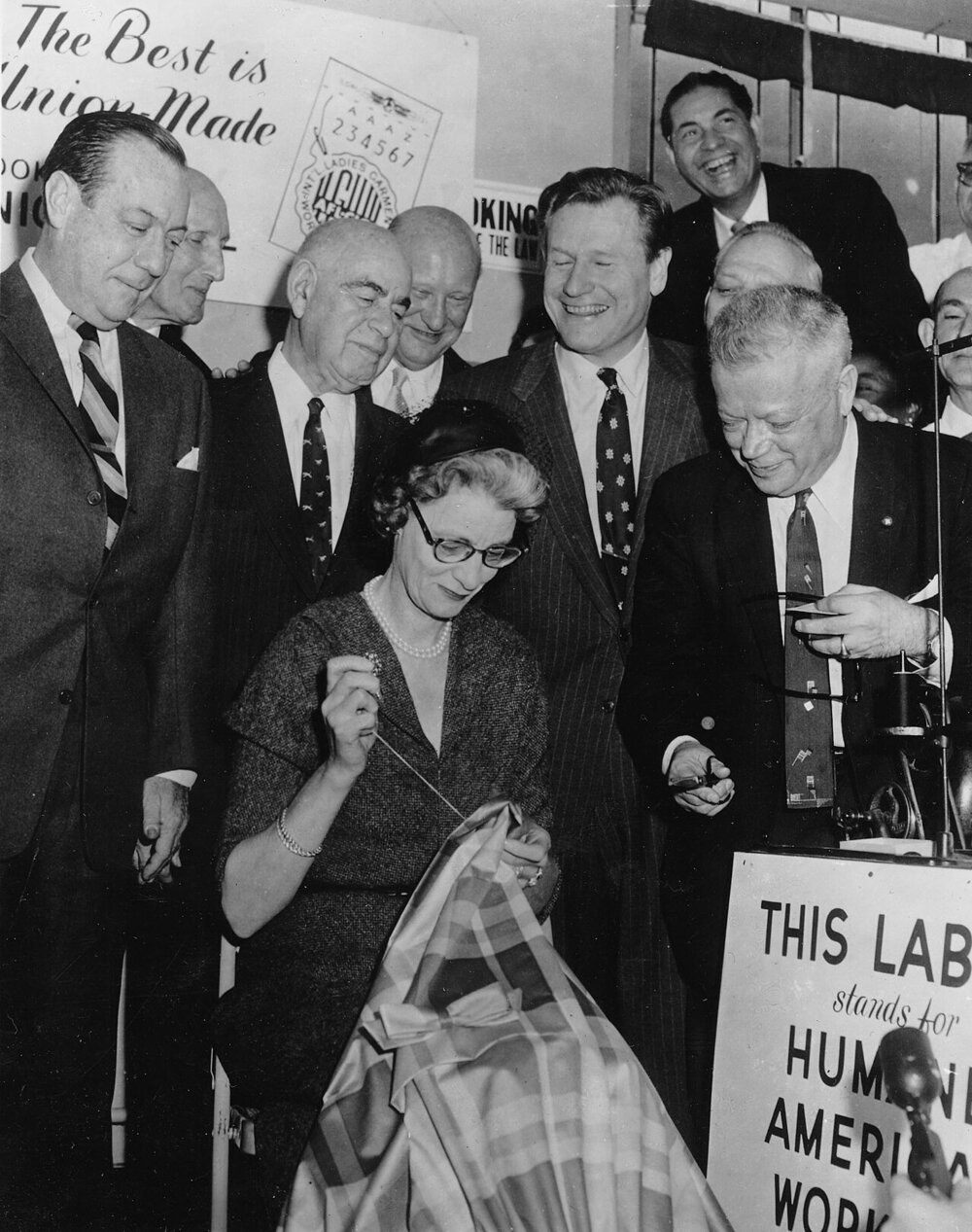 123
123- Code letters and serial number on the enlarged label: from 1959 these identified the employer
- AFL-CIO in the label seal: wording that means 1955 or later
- Mary Rockefeller sewing in a label; she was among the women at the 1959 label launch events
Canadian ILGWU labels
The ILGWU also organized Canadian shops, and Canadian labels have their own designs. Vintage Fashion Guild contributors date one Canadian design to 1957-1968 and another to 1968-1984. Canada did not follow the US changes, so a US date chart can mislead you on a Canadian label.
Where the sources disagree
The main dates (1955, 1974, 1995) are well supported. Some details are not:
- When did the 1955 design start? The Vintage Fashion Guild dates its example to "1955-1963". The Kheel Center's sample series for that design is headed 1959-1963, and Kheel also shows separate "pre-1955" labels. The label probably changed in 1955 to add "AFL-CIO", and then the 1959 industry-wide launch put it into many more garments. A label of this type is more likely late 1950s to early 1960s than 1955 itself.
- When did the ILGWU join the CIO? The Vintage Fashion Guild's union label page says 1935, while its quick dating tips say "briefly in 1937". Wikipedia and the ILGWU's history agree that it helped found the CIO committee in 1935 and went back to the AFL in 1940. None of this changes how you read a label: "AFL-CIO" wording means 1955 or later either way.
- What did the ILGWU merge with in 1995? You will sometimes read that it merged with the Amalgamated Clothing Workers of America. Strictly, the ACWA had already merged into the ACTWU in 1976, and it was the ACTWU that joined the ILGWU to form UNITE.
- "Look for the union label" ads. The famous TV jingle premiered in 1975. The ads tell you how well known the label was, not when your garment was made.
Men's clothing: ACWA labels
Men's suits, coats and shirts were usually made by members of the Amalgamated Clothing Workers of America (ACWA), founded in 1914. The Vintage Fashion Guild has a dated series of ACWA labels:
| Date | ACWA label detail |
|---|---|
| 1916 | First ACWA label |
| 1919 | Revised label |
| 1934 | New label, after a failed 1933 attempt to use the United Garment Workers label |
| 1935 | New label as the ACWA joined the CIO |
| 1939 | New label; WWII military versions are sepia toned |
| 1949 to 1962 | 1949 design without the registered mark (R in a circle) |
| 1962 to 1976 | 1949 design with the registered mark |
| 1976 to 1995 | ACTWU (Amalgamated Clothing and Textile Workers Union) after the 1976 merger |
Because the 1949 design ran so long, the registered mark is the detail to check: without it, the label is before 1962.
Other labels you will see alongside
- United Hatters, Cap and Millinery Workers (UHCMW): found in hats. The Vintage Fashion Guild shows one millinery label design used from 1934 to 1983, so on its own it is a weak dating clue.
- Fashion Originators Guild (FOGA): not a union. FOGA was a designers' group organized in 1932 to fight copying, and the Supreme Court ruled against its boycott practices in 1941. FOGA labels point to the 1930s and very early 1940s.
- New York Dress Institute / New York Creation: a promotional label created in 1941 for New York dress producers. Not a union label, and not a sign of high quality on its own.
How to read a union label in practice
- Find it. Union labels were often sewn into a side seam, or under or next to the size tag. From 1963 the union backed placing the label with or near the size tag, and combining it with the maker or fiber label where possible.
- Check the colors. Red, white and blue with "Made in U.S.A." means 1974 or later. That decides most cases at once.
- Look for AFL-CIO. Use a magnifier. If it is there, the garment is 1955 or later.
- Read the stress of the wording. Large "UNION MADE" on a blue-and-white label points to the 1963-1974 design.
- Cross-check with the other labels. A union label plus a care label tells you more than either does alone. For example, a 1963-1974 design with a sewn-in care label points to roughly 1972-1974. See dating by labels and care labels.
Does a union label add value?
Not much by itself. A union label confirms American (or Canadian) union manufacture and helps dating, and some buyers like that. Value still comes from the garment: style, maker, fabric and condition. See what makes vintage valuable. For dresses with ILGWU labels from the 1950s to the 1970s, you can check sold prices for vintage ILGWU label dress on eBay to see what similar pieces actually sell for.
A caution about reproductions
Union labels are small, and nobody sets out to fake them on cheap garments. But labels do get moved, and vintage-style brands sometimes use period-looking labels. If the label is crisp and bright while the garment is faded, or the stitching holding it does not match the garment's thread, check the construction as well. Our guides to dating by construction and reproduction vs. antique can help.
Not sure what you have? Appraise a photo
Sources
- Cornell Kheel Center — ILGWU Union Label Timeline
- Cornell Kheel Center — The Kheel Center ILGWU Collection
- Vintage Fashion Guild — Union Labels
- Vintage Fashion Guild — Amalgamated Clothing Workers of America labels
- Vintage Fashion Guild — Quick Tips for Dating Vintage
- Wikipedia — International Ladies' Garment Workers' Union
- Wikipedia — Fashion Originators' Guild of America
Free vintage label dating cheat sheet, by email:
Labels in this guide: ACWA (Amalgamated Clothing Workers of America)ILGWU
Eras: VictorianEdwardian1910s1920s1930s1940s1950s1960s1970s1980s
Related
- Dating Vintage Clothing by the Care LabelHow US, Canadian and European care labels date a garment: the 1971 FTC rule, the 1983 rewrite, 1997 symbols, and the clues that fool people.
- How to Date Vintage Clothing by Its ConstructionRead seams, stitching, seam finishes and cut to date vintage clothing, from hand sewing and chain stitch to pinked seams, overlocking and armhole gussets.
- How to Date Vintage Clothing by the LabelUse the laws, postcodes, fiber names and country names printed on a garment label to work out the earliest year it could have been made.
- Vintage Label Lookup: Date Clothing by Label, RN and Union TagFree printable vintage label dating cheat sheet with union label versions, RN and WPL numbers, care and fiber law dates, ZIP codes and zipper clues.